
Iron & Sulfur Filters in Putnam, Westchester & Fairfield County
Orange stains in the sink, black streaks in the toilet or a rotten egg smell usually mean iron, manganese or sulfur, in your water, which Cassidy Plumbing can treat. We test for all three and install the filter that removes what your water actually has.
Emergency Service Available 24/7
Or request service online →
What customers say about our iron and sulfur filter work
4.9 stars from 400+ Google reviews
What iron, manganese and sulfur look like
These minerals and gases are common in wells around here. Each one leaves its own clue.
How we fix stains and smells
We test for iron, manganese, hydrogen sulfide and pH together, because each one changes which filter will work. Low pH, for example, can keep some iron filters from doing their job.
Most iron and sulfur filters clean themselves by backwashing on a timer. They still need their media checked and topped up, and the control valve cleaned.
Our iron filter and sulfur filter maintenance plans handle that upkeep twice a year.
Iron filters
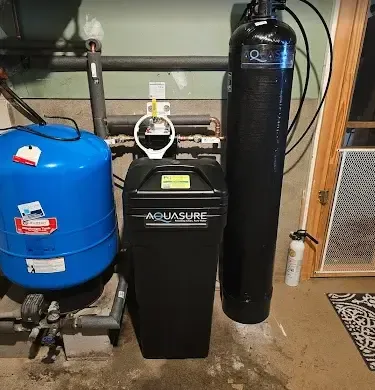
Backwashing filters that catch iron and manganese before they reach your fixtures.
Sulfur filters
Air injection and feed systems that take the rotten egg smell out of every tap.
Sediment filters
Cartridge or backwashing filters that clear up cloudy or gritty water.
What we treat, and with what
- Iron and rust, on wells or city water: an iron filter, or a softener when the amount is small.
- Manganese: an iron filter sized to handle both.
- Rotten egg smell (hydrogen sulfide): a sulfur filter, sometimes with a carbon stage after it.
- Sediment, cloudy or gritty water: a sediment filter ahead of everything else.
- Iron bacteria: slimy orange buildup in the toilet tank, which needs disinfection along with filtering.
Rotten egg smell? Check the water heater first
When the smell is only on the hot side, the culprit is usually the water heater’s anode rod, not the well. Swapping the rod for a different type often clears it up.
- Run a cold tap for a minute and smell the water.
- Now run a hot tap and do the same.
- Smell on both sides means the well. Hot side only means the water heater.
Our FAQ answer on sulfur smell covers the causes in a few lines.
Why homeowners call Cassidy
✓ The whole picture first
One test covers iron, manganese, sulfur and pH, so the first filter is the right one.
✓ Led by a master plumber
Founder Pat Cassidy is a master plumber, and we’re licensed and insured in New York and Connecticut.
✓ Family-owned since 1997
Based in Carmel, NY, and still run by the family that started it.
✓ We answer 24/7
Every day of the year, nights and holidays included. Your call always reaches a tech.
✓ We clean up
When we leave, the work area looks the way it did before we arrived.
✓ We explain the work
We show you what we found and walk you through the fix in plain language.
✓ Full price before work starts
You get the full price before any work starts, so there are no surprises on the bill.
Iron and sulfur filter questions, answered
Will an iron filter remove the orange stains I already have?
No, a filter stops new stains but doesn’t clean old ones. Once the water is clear, a rust stain remover takes care of most fixtures, and the stains stop coming back.
Can a water softener take out iron?
A softener can handle small amounts of dissolved iron. Heavier iron, manganese or iron bacteria foul the resin, so those homes need an iron filter in front of the softener. Your test results show which side of that line you’re on.
Why does my water come out clear and then turn orange?
That’s dissolved iron reacting with air once it leaves the pipe. It’s one of the most common things we see on local wells. A filter that changes the iron into particles and then traps them fixes it.
Does a sulfur filter need chemicals?
Some do and some don’t. Air injection filters use a pocket of air to break down the gas, while stronger smells may need a chlorine or peroxide feed. We pick the simplest setup that handles your level.
How often does an iron filter backwash?
Most backwash every few days, usually overnight, so you won’t notice it. The schedule depends on how much iron you have and how much water you use. We set it at install and adjust it at service visits.
More questions? See our FAQ.